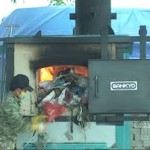
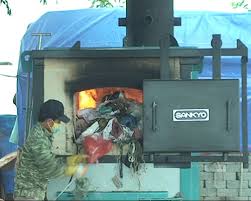
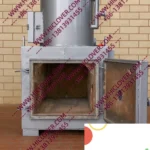
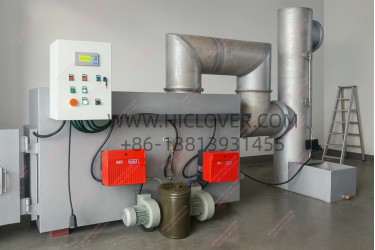
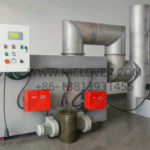
Doubel Combustion Chamber
All Incinerators are Doubel Combustion Chamber with One Fuel Burner Each. After Burner Technology for Completely Combustion and Cleaner World.
Large incinerators – INDUSTRIAL INCINERATORS – specs below.
2.) Size requirement for the incinerators is 750 — 850 kg capacity
3.) The bum rate should be 80 LL 100 kg/ hour.
4) The primary chamber shouId have an operating temperature of 900 -1200 degree C.
5) The incinerator should hate a high temperature secondary chamber and 2 second gas
retention time at 850- 1150 degree C so that it is suitable for high risk materials.
6). The incinerator should have temperature monitoring and thermostat control for ease of
operation and assurance of bum temperature to confirm correct operation.
7). The incinerator should be capable of burning any of the hazardous wastes listed in the
subsequent section.
8) The incinerator should be capable of burning diesel oil and should include a larger fuel
tank (10-500 litres) and generator (3 –40 kV) set that can be carried on the trailer with the
incinerator so that the unit requires no external electrical power supply.
9.) The incinerator should be trailer mounted so that it is a po
Hazardous Waste to be Incinerated
Hazardous solid chemical:
Different types of combustible solids, used textiles, grease, and toner cartridges, chemicals
for water purification and photographic consumables and plastic material, empty
plastic/metal cans that still contain remnant hazardous material, oil absorbent.
Hazardous liquid chemical:
Mainly different types. of Acid, Paint, Varnish, Acetone, White Spirit Aromatic-less
Solvents, Synthetic Liquid for Break Systems, Aircraft De-icing Liquid, Hydraulic and
Compressor oil, Freon, used in some older refrigeration units, Insecticide liquid/spray, air
refresh spray and other similar chemicals.
Contaminated fuel:
Mainly diesel or gasoline contaminated by water or solvents.
Used and/or Contaminated oil:
Used motor oils and/or mineral oils unfit for their originally intended use. Mainly motor
and gearbox oil (approximately 80%) contaminated by a mixture of white spirit and acetone (approximately 51%), hydraulic liquid (approximately 5%).
Contaminated water:
Waste oilshvater, leaches, hydrocarbons/water mixtures, emulsions and leachate.
Contaminated soil:
Soil polluted by oil, fuel or 11 chemicals.
Contaminated soil polluted by chemicals that has to be recycled in landfill.
Contaminated soil—treated and replaced on site.
Oil Contaminated Solids
Rags, Absorbents, Cardboard, oil and fuel filters, air filters are not consider as hazardous materials.
Electronic waste:
Waste electrical or electronic appliances or assemblies, including printed circuit boards,
containing toxic material and/or heavy metal and/or emitting low radiation.
Used battery cells:
Dry battery, UPS battery or other types, unsorted waste batteries/ battery cells, containing
materials that are hazardouy.
Used lead-acid batteries:
Waste lead-acid batteries, rained/un-drained, and whole or crushed.
Hazardous medical waste:
Clinical and related waste, arising from medical, nursing or similar practices and waste
generated in clinics during the investigation or treatment of patients (bio hazard).
Expired drugs, solid:
Waste pharmaceuticals, drugs and medicines, including sensitive medicines.
Expired drugs Iiquid:
Waste liquid pharmaceuticals, different type liquid chemicals for treatment, medical
grease, and paraffin based xpired medicines.
Expired and/or contaminated fod:
Spoiled fresh food or unusable MRE’s (Meal Ready for Eat – dry food)
Onsite Training and Assem Option for Industrial Incinerators
I. The bidders should includ 1a price in their offer for training in a central location ( Goma or
Bukavu) approximately 15 staff in the operation and maintenance of the
equipment.
VietNamNet Bridge – While Vietnamese made medical and domestic waste incinerators are finding it difficult to enter the commercial market, foreign-made incinerators have been imported in great numbers.
Vinh Phuc, Phu Tho, Nam Dinh, Thai Binh and Bac Giang provinces have all imported small-scale incinerators to treat domestic waste
The outdated equipment is unsuited to Vietnamese conditions. While many countries now say ‘no’ to incineration technology, Vietnam pays the price for buying the machines.
Trinh Dinh Nang from Hoa Tu Long Thermal Industry Company in Bac Kan province was not surprised after hearing that Vinh Phuc Province’s Science & Technology Department imported an NF105 incinerator worth VND2.25 billion from Thailand and another seven incinerators later.
He knew that Vietnamese preferred foreign-made products rather than domestically made ones. However, he said foreign-made incinerators might do more harm than good.
There are differences in Vietnamese and foreign waste; in many cases, foreign incinerators may even cause problems or be useless.
“In other countries, waste is classified before it is put into treatment. In Vietnam waste is not classified. Treating waste with foreign-made incinerators cannot ensure environmental safety,” he warned.
The inventor of a low-cost incinerator, Nang understands the features and efficiency of incinerators of different kinds. However, he finds it difficult to sell incinerators because buyers prefer foreign made products.
Nang’s incinerator burns garbage at a high temperature of 1,800oC which allows complete burning of waste with the capacity of 30-50 kilos per hour.
Meanwhile, the dust & smoke treatment unit ensures that dioxin and furan will not be recreated during the burning process.
The great advantage of Nang’s incinerator is low operation cost – VND5,000 per kilo when treating waste with diesel and VND2,000 per kilo with waste oil.
The incinerator is the first product of its kind in Vietnam which can satisfy the National Standard No 30 set by the Ministry of Natural Resources and the Environment.
“When I introduced my incinerator in Cao Bang, local officials said they liked it very much, but they did not have money to buy,” he said.
“When I talked about the incinerator in other localities, local officials hesitated to buy it because the incinerator has not been used in other provinces,” he complained.
A thermal technology expert noted that local authorities prefer imports because they get benefits when buying products from overseas.
“No one knows the real value of foreign made products and technologies. It is easy to exaggerate the import price,” he noted.
Dat Viet
http://english.vietnamnet.vn/fms/science-it/139786/vietnam-pays-heavy-price-for-incinerator-imports.html
Technological University of Panama: an environmental research about the municipal waste in Panama city. I found some incinerators from Clover Incinerator and I think they are perfect for my research but I have a question and it is if the incinerator can have a waste sluice additional to it?
University of Bologna:We are designing a bioreactor for human waste; the digestate is useless for fertiizing the soil. The only solution for digestate disposal is burning it. Throught your on-line page, we saw the Model: SYC-50 Incinerator that could be perfect for our trouble. The question is: natual gas, like biogas is a correct fuel? And what is the right quantity of fuel necessary for burning?
Incinerator Suppliers in Rwanda: Modern Waste Incinerator Solutions for a Sustainable Future
Rwanda is widely recognized for its strong environmental policies, healthcare reforms, and commitment to sustainable development. As these initiatives expand, the demand for reliable waste incinerator systems continues to grow. Hospitals, laboratories, municipalities, and international organizations are increasingly searching for dependable incinerator suppliers in Rwanda that can deliver compliant, efficient, and future-ready waste treatment solutions.
HICLOVER addresses this demand as a factory-based manufacturer, supplying industrial incinerators designed for automation, mobility, and rapid deployment under African operating conditions.
Several factors are driving the adoption of modern incineration in Rwanda:
Expansion of national and regional healthcare facilities
Strict policies on environmental protection and public hygiene
Growth of urban centers and concentrated waste generation
Preference for compact, modular infrastructure with minimal site impact
In this environment, controlled incineration remains a practical and proven method for handling medical, hazardous, and regulated waste streams.
When evaluating incinerator suppliers in Rwanda, the distinction between a manufacturer and a reseller is critical. HICLOVER operates as a direct factory supplier, offering advantages that support long-term project stability:
Direct engineering support and technical communication
Stable configurations without frequent component changes
Custom-built systems matched to waste type and capacity needs
Long-term spare parts availability and technical continuity
A full overview of the manufacturer and product portfolio can be found at
https://www.hiclover.com/
HICLOVER waste incinerators are designed to support a wide range of applications aligned with Rwanda’s development priorities:
Medical and Healthcare Waste
Incineration of infectious waste, sharps, pharmaceuticals, and pathological materials using dual-chamber systems with automated temperature control.
Municipal and Community Facilities
Compact and medium-capacity incinerators for district hospitals, towns, and service centers where landfill options are limited.
NGO and Development Projects
Reliable solutions for donor-funded healthcare, sanitation, and emergency response programs.
Animal and Veterinary Waste
Safe destruction of animal remains and by-products with controlled combustion and low residual ash.
Flexibility is a defining requirement for modern waste incinerator deployment. HICLOVER integrates modular design principles to simplify logistics and installation:
Containerized mobile incinerators for fast deployment
Skid-mounted or trailer-mounted configurations
Modular systems requiring minimal civil works
Plug-and-operate designs that reduce on-site setup time
These features are particularly valuable in Rwanda, where efficiency, land use, and project timelines are carefully managed.
HICLOVER incinerators are engineered with automation at the core to improve safety, consistency, and operational efficiency:
PLC-based control systems with real-time monitoring
Automatic burner sequencing and safety interlocks
Stable combustion logic for optimized fuel consumption
Optional data logging for compliance and reporting
Key technical features include:
High-grade refractory linings for extended service life
Multi-stage combustion chambers for complete oxidation
Optional flue-gas treatment modules based on project requirements
This approach aligns with global trends toward smart infrastructure, reduced operator dependency, and transparent environmental performance.
For organizations comparing incinerator suppliers in Rwanda, experienced buyers focus on lifecycle reliability rather than initial purchase price. Important considerations include:
Manufacturer capability versus intermediary sourcing
Experience supplying equipment to Africa and similar regions
Availability of mobile and modular systems
Quality of documentation, drawings, and training support
Factory-backed suppliers reduce operational risk and support long-term sustainability goals.
The growing focus on waste infrastructure in Rwanda is reflected in online search activity. A live Google search reference for this topic is available here:
https://www.google.com/search?q=incinerator+suppliers+in+rwanda
This trend mirrors broader regional attention to healthcare resilience, environmental compliance, and sustainable urban development.
As Rwanda continues to strengthen its waste management and healthcare systems, modern waste incinerator technology plays an essential role. For organizations seeking reliable incinerator suppliers in Rwanda, factory-direct manufacturers like HICLOVER provide automation, modular flexibility, and technical depth aligned with both current operational needs and long-term sustainability objectives.
Résumé en français
Au Rwanda, la gestion des déchets repose de plus en plus sur des incinérateurs modernes, automatisés et modulaires. Les fournisseurs directs d’usine offrent fiabilité, efficacité et soutien technique durable.
Resumen en español
En Ruanda, los incineradores de residuos son clave para la salud pública y el medio ambiente. Los proveedores de fábrica con sistemas móviles y automatizados garantizan eficiencia, flexibilidad y soporte a largo plazo.
2026-01-09/09:13:51
|
Incinerator Items/Model |
HICLOVER TS100(PLC)
|
|
Burn Rate (Average) |
100kg/hour |
|
Feed Capacity(Average) |
150kg/feeding |
|
Control Mode |
PLC Automatic |
|
Intelligent Sensor |
Continuously Feeding with Worker Protection |
|
High Temperature Retention(HTR) |
Yes (Adjustable) |
|
Intelligent Save Fuel Function |
Yes |
|
Primary Combustion Chamber |
1200Liters(1.2m3) |
|
Internal Dimensions |
120x100x100cm |
|
Secondary Chamber |
600L |
|
Smoke Filter Chamber |
Yes |
|
Feed Mode |
Manual |
|
Burner Type |
Italy Brand |
|
Temperature Monitor |
Yes |
|
Temperature Thermometer |
Corundum Probe Tube, 1400℃Rate. |
|
Temperature Protection |
Yes |
|
Automatic Cooling |
Yes |
|
Automatic False Alarm |
Yes |
|
Automatic Protection Operator(APO) |
Yes |
|
Time Setting |
Yes |
|
Progress Display Bar |
3.7 in” LCD Screen |
|
Oil Tank |
200L |
|
Chimney Type |
Stainless Steel 304 |
|
1st. Chamber Temperature |
800℃–1000℃ |
|
2nd. Chamber Temperature |
1000℃-1300℃ |
|
Residency Time |
2.0 Sec. |
|
Gross Weight |
7000kg |
|
External Dimensions |
270x170x190cm(Incinerator Main Body) |
|
Burner operation |
Automatic On/Off |
|
Dry Scrubber |
Optional |
|
Wet Scrubber |
Optional |
|
Top Loading Door |
Optional |
|
Asbestos Mercury Material |
None |
|
Heat Heart Technology(HHT) |
Optional |
|
Dual Fuel Type(Oil&Gas) |
Optional |
|
Dual Control Mode(Manual/Automatic) |
Optional |
|
Temperature Record |
Optional |
|
Enhanced Temperature Thermometer |
Optional |
|
Incinerator Operator PPE Kits |
Optional |
|
Backup Spare Parts Kits |
Optional |
|
Mobile Type |
Optional:Containerized/Trailer/Sledge Optional |
Estimados, agradecería una cotización por los hornos crematorios para mascotas modelo YD-30 / YD-50.Mobile Diesel Fired Incinerator model
supplied with the following specifications:
complete with constant ventilation fans for extraction,
factory installed inside one 20ft ISO container complete with lighting, ventilation fan, fire security, 3 access doors, and a 1200 litre fuel tank complete with a piping.
Fully containerised mobile waste management solution for medical, animal, and industrial waste applications.
Installed in Container (ISO) : 20”
or its nearest equivalent model plan to build a incinerator plant with 3 units of incinerators at the capacity of 500kg per hour each.
Together with other facilities like operation office, store, space to clean waste containers and 3-4 worker living quarters.
Necesito saber
1.ficha tecnida
2.guía mecanica
3.elevaciones
4. Los quemadores son Ecologicos.?? 5.’caracteristicas generales
Del YD 50 and. YD 100 Long Life pet crematory
in Diesel ….Me interesa este producto Long Life Pet Crematory (YD-50), y quiero conocer más detalles sobre:
Dame la lista de precios exactos por favor.
Me gustaría pedir algunas muestras. ¿Podría enviarme la lista de precios de muestras?Raw Medical Waste Incinerators. Can you please provide an official cost quote for purchase of (2) incinerators, whichever model has a comparable Capacity = 30 kg/hr.
Waste calorific value : 4000KCAL/KG
Moisture Content : 10-25%
Nominal Capacity : 50Kg/Hour batch load
Secondary Chamber : 2 Seconds @ 850degrees C
The primary combustion chamber must ensure minimum exit temperature is not less than 850 degrees C.
INSULATION
Calcium Silicate
Limiting Continuous service limit 1000 degrees C.
Thickness 25mm
THROUGHPUT
50kg/hour at a nominal calorific value of 4,000 kcal/kg and an average bulk density of 120kg/MCubed for general waste and 160kg/MCubed for health care waste.All types of chemicals substances (Biocides) that utilized for Oil operation sites (water base Drilling, oil operating facilities for the corrosion and others: The examples of the biocides are “WS-36, HAI-85M, SODA ASH, DSMA, MICRO MATRIX, CALCIUM CARBONATE FINE, BARAKLEAN, GILSONITE, MIXED WASTE SOIL CHEMICALS, ZINC CARBONATE, CAUSTIC SODA, ENVIROTHIN, BARAZAN D,..etc) as well as the substances are liquid and solid.
2. In regards to the quantity of burning the waste, it could be 200 – 500 kg per hour.
3. Our Operational time can be in Day and can be at night.
4. Can you please give me the cost of unit operated with Diesel and Gas.The primary combustion chamber is the main structure of the incinerator, fabricated from mild steel plate and stiffened with rolled steel sections. It is carried from the floor level on a substantial steel support frame. Internally the shell is lined with calcium silicate insulation and a hot face combination of super duty brickwork or high strength castable.
The primary combustion chamber must ensure minimum exit temperature is not less than 850°C.
One Manual Load Incinerator comprising:
·???????? Manual Loading door
·???????? Horizontal solid hearth, refractory lined primary combustion chamber. Approximate dimensions 800 mm diameters x 2100mm long
·???????? Full sized bulk load/ash removal door
·???????? 1 off diesel-fired ignition burner — temperature controlled
·???????? 1 off combustion air supply fan and distribution system, automatic control
·???????? High capacity secondary combustion chamber with residence time not less than 2 seconds @ >850°C
·???????? 1 off diesel-fired afterburner — temperature controlled
·???????? Control panel — automatic operation
e????? Temperature indication primary and secondary chambers 0-1200°C
e????? Refractory lined flanged chimney to a height of 10M above ground level